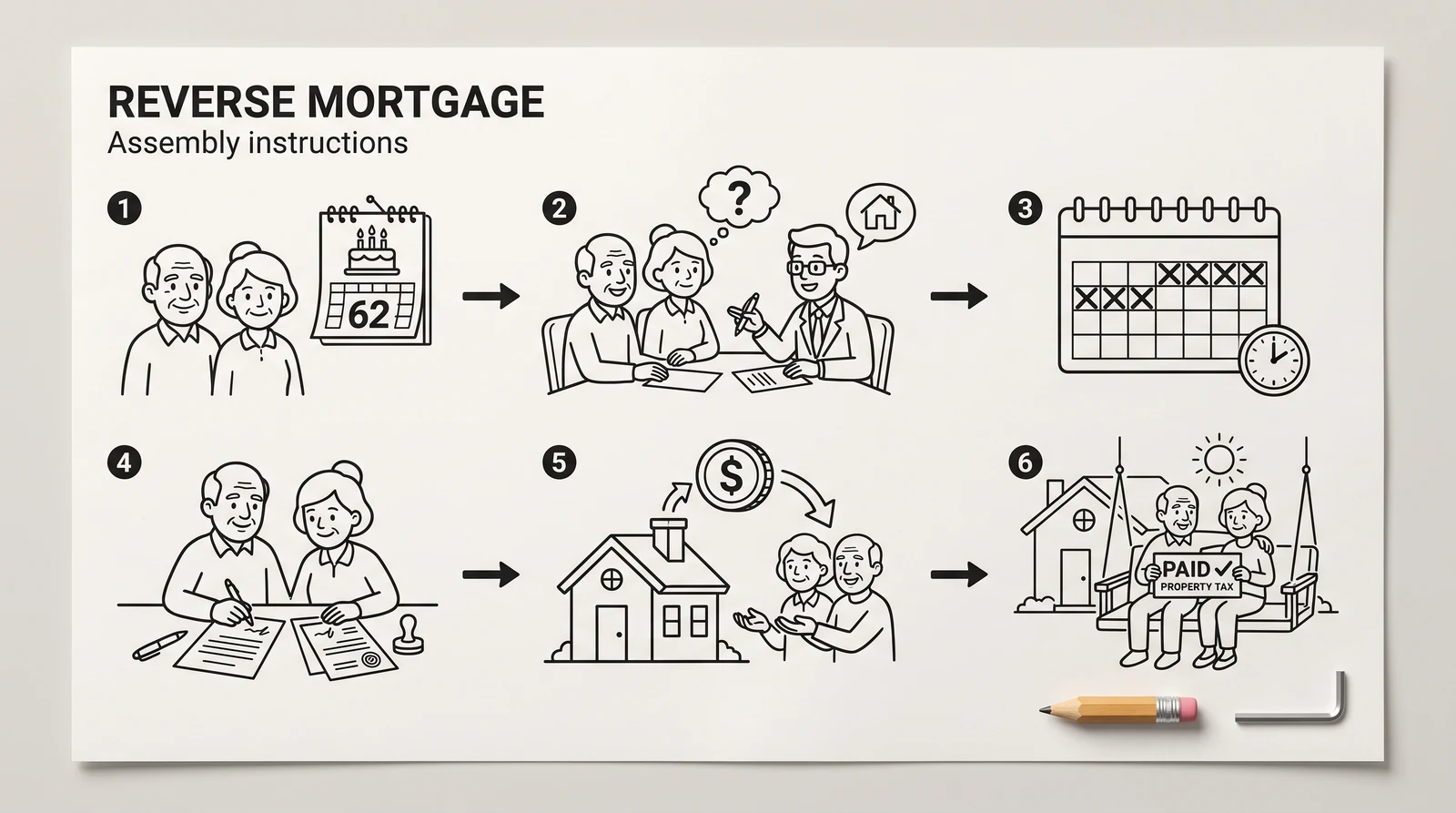


A reverse mortgage follows the same path for everyone who takes one, because the federal Home Equity Conversion Mortgage (HECM) program sets the rules in HUD's regulation, 24 CFR part 206. Most of the confusion comes from seeing the pieces out of order: the counseling, the waiting period, the payout choice and the bills you still pay. This page puts them in the order they happen, from the first question to the day the loan is paid off, with the extra step California adds. Each step links to a deeper guide if you want the detail.
Step 1: Check that the basics fit
Three conditions come first.
- Under 24 CFR 206.33, the youngest borrower must be 62 or older at closing. If one spouse is younger, read up on the rules for a non-borrowing spouse before you go further.
- The home has to be your principal residence. A rental or a vacation home doesn't qualify.
- You need enough equity. Any mortgage you still owe gets paid off from the reverse mortgage at closing. If the existing balance is larger than what the HECM can pay, the numbers don't work without bringing cash.
Our guide on how to qualify for a reverse mortgage covers the eligibility rules in full.
Step 2: Get a rough idea of the amount
HUD's formula uses three inputs: the age of the youngest borrower (or eligible non-borrowing spouse), the current interest rate, and your home's value. The value used is the lowest of the appraised value, the FHA lending limit, or the sales price if you're buying. For FHA case numbers assigned in 2026, that limit is $1,249,125 nationwide, set by HUD Mortgagee Letter 2025-22.
That limit caps the home value HUD will count, and no one receives it as a payout. If your home is worth more, the limit is the figure that goes into the math, and owners of higher-value homes sometimes compare a jumbo reverse mortgage. An honest estimate needs your age, your address and the day's rates, so treat any online figure as a starting point.
Step 3: Talk with a HUD-approved counselor
Every HECM borrower goes through counseling with an independent counselor approved by HUD. Under 24 CFR 206.41, the lender has to give you a list of approved counselors at your first contact, and the borrower, any non-borrowing spouse and any other owner on title must all take part. The counselor walks you through how the loan works, what it costs, what you'll still owe each year, and what else you could do instead.
You leave with a counseling certificate, and the lender can't go forward without it. Our article on what happens in reverse mortgage counseling explains who attends, what it covers and what to bring.
Step 4: Wait seven days (California only)
California adds a pause that most states don't have. Civil Code section 1923.2(k) says a lender can't accept a final and complete application, or charge you any fees, until seven days after your counseling, and until it has the signed counseling certification. Use the week. Read the paperwork from your session, ask your family any questions you were saving, and compare offers if you want to. Nobody can rush you through this step, which is also why a "sign today" pitch is a warning sign. Our guide to reverse mortgage scams lists the others.
Step 5: Apply, and let the lender check the numbers
After the wait, you file the full application. The lender orders an FHA appraisal of the home and runs a financial assessment: a look at your income, credit and bill-paying history to see whether you can keep up with property taxes, homeowners insurance and upkeep for the long run. If that review raises a concern, the lender can hold back part of the loan in a Life Expectancy Set-Aside, a reserve used to pay those bills for you. 24 CFR 206.205 sets out how those charges get paid, and the set-aside is one of the ways.
Step 6: Close, then wait out the three days
At closing you sign the loan documents. Upfront costs, including FHA mortgage insurance, the origination fee and third-party charges, can be paid in cash or out of the loan itself. Our breakdown of what a reverse mortgage costs goes through each one.
Unless you're using the HECM to buy a home, federal lending law gives you a three-day right to cancel after signing, even if your home is paid off. HUD's rule, 24 CFR 206.25(d), says no loan money goes out until that period has passed. Once it ends, the lender pays off any existing mortgage and the rest becomes available to you.
Step 7: Choose how the money reaches you
HUD's regulation, 24 CFR 206.19, lists the payout options: one lump sum, monthly payments for as long as you live in the home (tenure), monthly payments for a set number of months (term), a line of credit, or monthly payments combined with a line of credit. A fixed-rate HECM pays a single lump sum and nothing after. The other options come with an adjustable rate. You choose before closing, and on an adjustable-rate loan you can usually change the plan later. Our guide to lump sum, monthly or line of credit compares them and explains the first-year limit.
Step 8: Live in the home and keep up the bills
This is the longest step, and for most people it lasts years. You make no monthly mortgage payment. Instead, under 24 CFR 206.19(g), interest is charged from the day the money is paid out and added to your balance each month. The CFPB describes it plainly: interest and fees are added to the loan balance each month and the balance grows. Your equity shrinks as the balance rises, which is the trade you make for not paying.
What you keep paying are the home's own bills. 24 CFR 206.205 makes the borrower responsible for property taxes, homeowners and flood insurance, and any HOA or condo dues, and you keep the home in good repair. In Orange County, the Treasurer-Tax Collector's calendar puts the first property tax installment due November 1, with a 10% penalty if it isn't postmarked by December 10. The second is due February 1 and the last day to pay is April 10. Missing these is one of the ways a reverse mortgage gets called due, so many borrowers set the dates in their phone or let a set-aside handle them.
Step 9: Know what ends the loan
Under 24 CFR 206.27(c), the balance comes due when:
- the last surviving borrower dies, or sells or signs over the home;
- the home stops being your principal residence;
- you're away from it for more than 12 months in a row because of physical or mental illness, such as a long stay in a care facility;
- property taxes or insurance aren't paid; or
- another obligation of the loan isn't kept.
If a borrower dies and an eligible non-borrowing spouse is still living in the home, that spouse may be able to stay, provided the conditions set at closing are met.
Step 10: The loan is repaid
The CFPB notes that the loan is usually repaid by selling the home. You or your heirs can also keep the house by paying off the balance from savings or a new loan. Any money left over after the payoff belongs to you or your estate.
If the balance has grown larger than the home is worth, the HECM's non-recourse rule protects you. Under 24 CFR 206.27(b)(8), the borrower has no personal liability for the balance, the lender can collect only through the sale of the property, and it can't get a deficiency judgment. FHA mortgage insurance covers the gap. Our article on what happens to the house when you die walks through the timeline your heirs would face.
Where to go from here
The steps are the same for every HECM borrower. The numbers depend on your age, your home's value, the mortgage you still owe and what you want the money for. A reverse mortgage isn't the right answer for everyone, and a HELOC, a refinance or selling can fit better. Esther Buede at Choice Home Mortgage in Fountain Valley can run an estimate for your home and tell you plainly if it doesn't add up. For the rules that only apply in this state, read reverse mortgages in California. Start on our reverse mortgage page, or call (949) 522-7310.