

Most reverse mortgage scams go after the cash the loan releases. Someone talks an older homeowner into a reverse mortgage they don't need, then steers the money into an annuity, a "can't miss" investment, an overpriced repair job, or their own pocket. Other schemes sell information HUD gives away free, or make a private lender look like a government office. Federal and California law already build in the main defenses: an independent counselor you choose yourself, a seven-day wait before a California lender can take your application, and a ban on tying the loan to an annuity.
The schemes federal agencies keep warning about
The Consumer Financial Protection Bureau lists four patterns it sees with reverse mortgages:
- A trusted family member or caregiver pressures the homeowner into applying.
- Someone uses the homeowner's identity, Social Security number, or other personal information to get the loan money without the homeowner knowing.
- A borrower is tempted to put the loan money into a "can't miss" investment or costly home repairs.
- Someone talks the borrower into signing a power of attorney that gives them sole access to the loan funds.
The FBI describes the same thing from the investigator's side. Its Portland field office wrote in 2021 that fraudsters look for seniors who don't know the requirements or the process, push them into reverse mortgages that don't fit, and then pressure them to spend part of the money on an expensive annuity "that may not even mature for many years."
The simplest scheme sells you something that is free. HUD's own reverse mortgage page warns about "scam artists that charge thousands of dollars for information that is free from HUD." Counseling information, the list of approved counselors, and the list of FHA-approved lenders are all free.
Ads that make a loan sound like a government benefit
A reverse mortgage is a loan. It has fees and interest that compounds, and you can lose the home if you fall behind on property taxes or homeowners insurance. The CFPB put out a consumer advisory in 2015 because ads kept leaving people with the opposite impression: that the product was risk-free, a government benefit, or a guarantee they could stay in the home for life. The FHA insurance on a HECM is real, but borrowers pay for it through their mortgage insurance premiums.
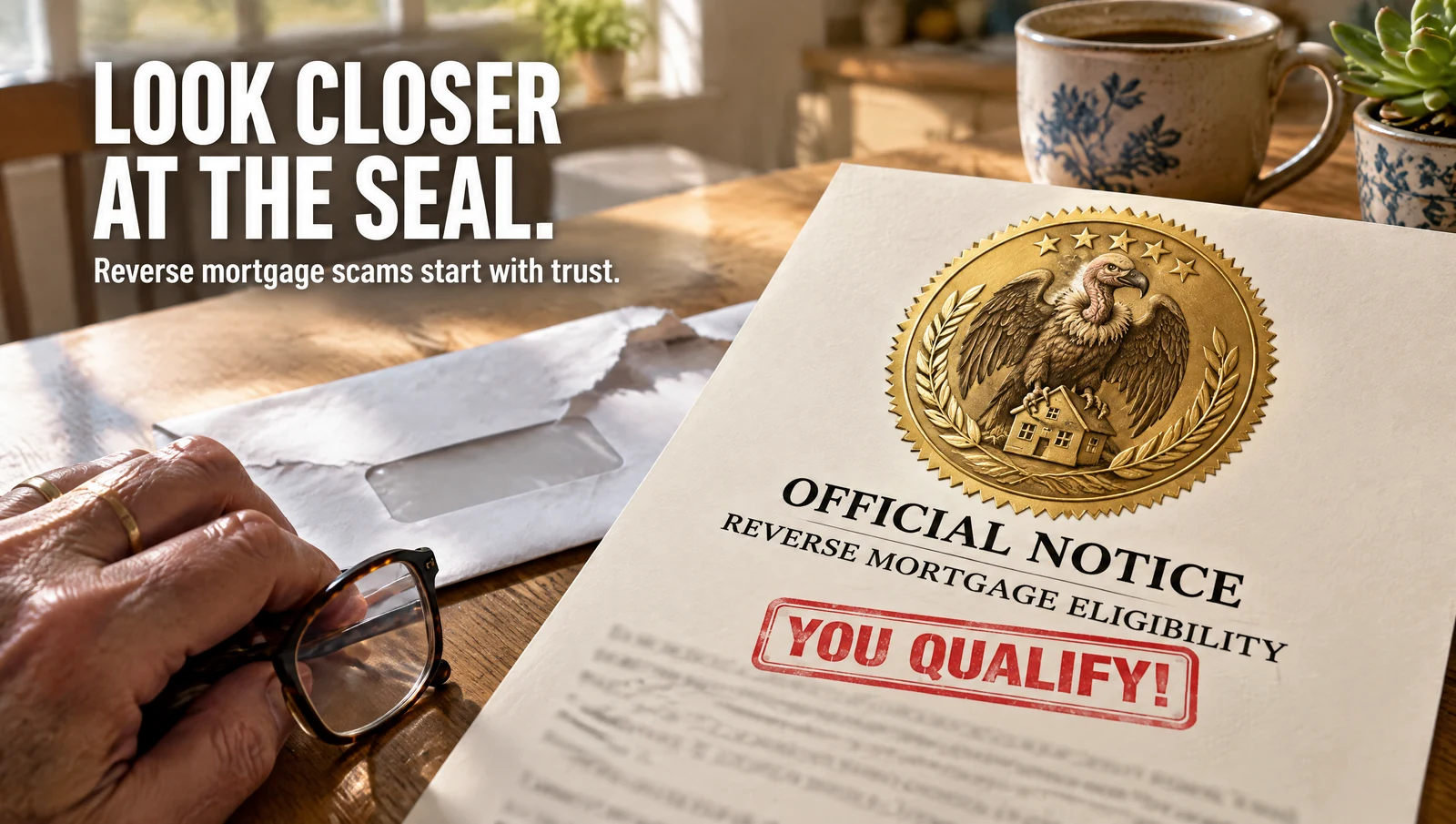
In December 2016 the CFPB fined three reverse mortgage advertisers over those claims: American Advisors Group ($400,000), Reverse Mortgage Solutions ($325,000), and Aegean Financial ($65,000). All three told consumers they could not lose their homes. Aegean also told people "you qualify for a reverse mortgage from the United States Housing Department." There is no such department; the federal housing agency is HUD. In a separate case, the CFPB found reverse mortgage mailers printed with an eagle resembling the Great Seal and the header "GOVERNMENT LENDING DIVISION."
HUD's description is plain: the only reverse mortgage the federal government insures is the Home Equity Conversion Mortgage (HECM), and you can only get one through an FHA-approved lender. If a letter looks official, check the sender against HUD's Lender List Search before you call the number on it.
The annuity pitch, and why California law blocks it
California deals with the annuity pitch directly. Under Civil Code § 1923.2(i), a lender or anyone else taking part in the loan cannot require you to buy an annuity to get a reverse mortgage. They also cannot refer you to anyone to buy an annuity or any other financial or insurance product before the loan closes or before your right to cancel runs out. The law still lets a lender arrange title insurance and hazard or flood insurance, which a home loan normally needs.
Federal guidance says the same thing in plainer words. The Federal Trade Commission: "You don't have to buy any financial products, services, or investment to get a reverse mortgage." The CFPB: "Reverse mortgage loan officers are not allowed to sell you investments." So if the person helping you with the loan brings up an annuity, a long-term care policy, or an investment account for the proceeds, treat it as a warning sign.
Pressure, contractors, and paperwork you didn't plan to sign
The FTC's advice on high-pressure sales fits in one line: if you feel pressured to finish the deal in a hurry, walk away. A legitimate lender can tell you in writing where any deadline it mentions comes from.
A contractor who brings up a reverse mortgage to pay for a roof or a remodel deserves the same caution. The CFPB says not to take a reverse mortgage only because a contractor recommends it. If repairs are the reason, get the repair bids first, then talk to a lender and a counselor separately.
Watch for documents that move control of your money. A power of attorney or a new name on a bank account can hand someone else access to the loan proceeds, and a deed transfer can hand them the house. HUD's counseling certificate also has the counselor ask whether you signed up with an estate planning service firm that charges a fee, and whether you could get the same help for little or no cost elsewhere. More on what the session covers is in what happens in reverse mortgage counseling.
California rules that slow a scammer down
Civil Code § 1923.2 sets several protections that apply to reverse mortgages in general, the HECM and private loans alike:
- Before taking your final application, the lender has to give you a list of at least 10 HUD-approved counseling agencies. The agency you use cannot be paid, directly or indirectly, by the lender or by anyone selling annuities, investments, or insurance.
- The lender cannot accept a final application or charge you any fee until seven days after counseling, and it needs the counseling certification signed by you and the counselor.
- The first page of the deed of trust has to say, in 10-point bold type, "This deed of trust secures a reverse mortgage loan." If someone hands you papers for a reverse mortgage and that line is missing, stop and ask why.
A second rule matters in our part of Orange County. Civil Code § 1632 says that when a reverse mortgage is negotiated mainly in Spanish, Chinese, Tagalog, Vietnamese, or Korean, the borrower must get a translation of every term in that language before signing. Little Saigon in Westminster and Garden Grove sits a few minutes from our Fountain Valley office. A reverse mortgage pitched there in Vietnamese has to come with the full contract in Vietnamese. A salesperson who negotiates in one of those five languages and then hands over English-only papers is not following § 1632.
After closing, the FTC says most reverse mortgages give you at least three business days to cancel for any reason. Saturdays count; Sundays and federal holidays do not. Send the cancellation in writing by certified mail with a return receipt, and keep copies.
Higher-value Orange County homes and private reverse mortgages
In 2026, HUD's maximum claim amount for a HECM is $1,249,125 (Mortgagee Letter 2025-22), the same as Orange County's 2026 FHFA conforming loan limit. That figure caps the home value the HECM formula can use; no one receives it as a payout. If your home is worth more than that, you may also hear about private, or proprietary, reverse mortgages. Those are legitimate products with their own rules. California's annuity ban, counselor list, and seven-day wait in § 1923.2 still apply to them, so a private reverse mortgage that skips any of those steps has a problem.
Checks you can run yourself
- Look up the loan officer and the company on NMLS Consumer Access (nmlsconsumeraccess.org). Choice Home Mortgage is NMLS #2629064, and Esther Buede is NMLS #2003644.
- For a HECM, confirm the lender on HUD's Lender List Search.
- Pick your own counselor from HUD's list or by calling (800) 569-4287. Be wary if the salesperson insists on booking one for you.
- Don't respond to unsolicited ads or mailers, and don't sign anything you don't fully understand. Both tips come from the FBI.
- Talk to more than one lender before you choose, as the CFPB suggests.
- Turn down any annuity, insurance policy, or investment offered before closing or during the cancellation window.
Where to report a reverse mortgage scam
In Orange County, call Adult Protective Services at 1-800-451-5155. The line runs 24 hours, and the county says the most frequently reported abuse by others is financial. You can also report to the FTC at ReportFraud.ftc.gov, or to the FBI's Internet Crime Complaint Center at ic3.gov if the contact came online. If you already have a reverse mortgage and something about it worries you, a HUD-approved counselor at (800) 569-4287 can go over the paperwork with you.
Talk it over before you sign
If someone has pitched you or a parent a reverse mortgage and the offer doesn't sit right, owner Esther Buede at Choice Home Mortgage will go through it with you, including whether the steps above happened and in what order. For the rest of the picture, see what a reverse mortgage costs, how to qualify, and how a reverse mortgage works in California, or the full reverse mortgage page. Call (949) 522-7310.